How micro-reflections turn passing moments into memory, meaning, and momentum
We often think of time as something to manage but research suggests it’s something we can reshape.
By noticing more, even for seconds at a time, we can change how long our days feel, how clearly we remember them, and how connected we feel to ourselves.
1. Tiny pauses, bigger days
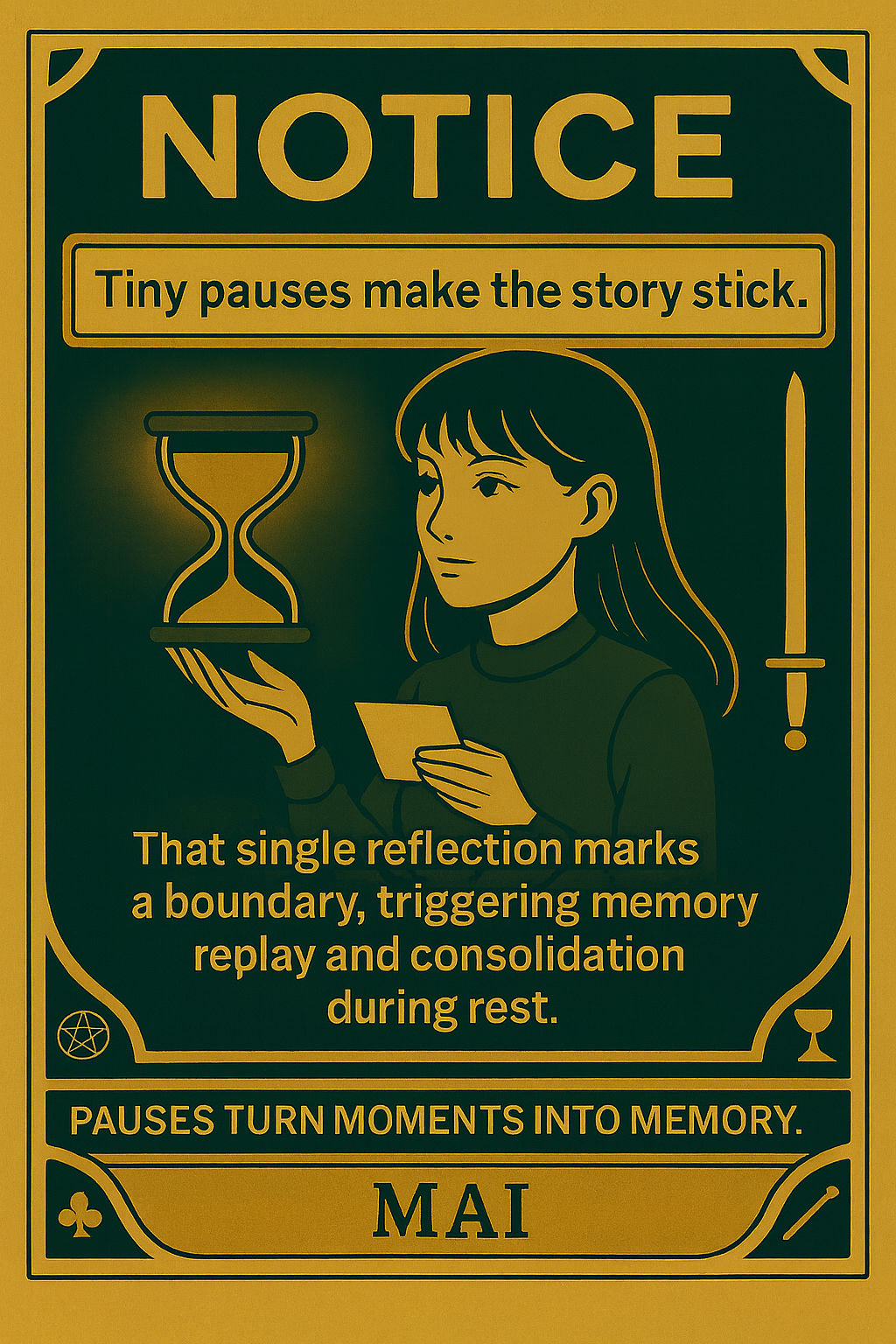
Across hundreds of diary and neuroscience studies, one consistent finding emerges: when people take 10–60 seconds to pause after a meeting, a workout, or a moment that felt meaningful, the brain flags that instant as a boundary.
Boundaries mark the edges of experience, signaling, “Something just happened.”
Each small note, whether a line of text or a quick voice memo, strengthens encoding and later recall.
These “micro-reflections” create what researchers call temporal richness; the sense that a day contained more distinct, memorable scenes. Participants who practiced brief gratitude or noticing prompts described their days as longer, fuller, and more satisfying.
2. The science behind the five-second note
Studies outline a common mechanistic chain:
- Attentional calibration – A short pause widens awareness, helping you register color, tone, and context instead of rushing past them.
- Dopaminergic reinforcement – The small emotional “ping” of noticing or gratitude triggers reward circuits, helping the brain decide, Keep this one.
- Event segmentation – Those mini-moments become clear memory units, later stitched into a coherent story of the day.
- Retrieval and replay – Writing a one-line summary acts as active recall, boosting consolidation during rest or sleep.
- Autobiographical reconstruction – Over time, these traces form a stable self-narrative showing proof of progress, continuity, and identity.
In short: micro-reflections transform fleeting attention into durable self-trust.
3. From memory to identity
The Five Second Journal research extends this logic beyond memory.
It shows that when reflections happen at natural boundaries; they strengthen the story we tell about who we are.
Each note becomes a micro-rehearsal of identity: “I finished what I started.” “I stayed present.”
Repeated over weeks, these small signals consolidate into habits and self-beliefs, creating behavioral persistence that lasts long after the journal closes.
This “identity stitching” process has been linked to greater self-efficacy, motivation, and resilience, even when total writing time stays under two minutes per day.
4. Why this matters now
In an age of chronic distraction and time scarcity, these findings offer something quietly radical:
You don’t need to journal for an hour or meditate on a mountaintop to feel more grounded in your life.
A few short, honest, and consistent boundary-aware notes can make days feel longer, stories clearer, and motivation steadier.
Organizations are beginning to apply these insights, too. Workplace pilots using opt-in micro-prompts (like 30-second gratitude cues before meetings) report less burnout and better recall of key decisions providing participation stays voluntary and private.
5. Ethical design and real-world caution
Studies emphasize that less is more.
Prompts must remain optional, context-sensitive, and privacy-protected to avoid fatigue or surveillance.
The goal is not constant self-tracking but restoring a rhythm of noticing. Brief moments that mark time as lived, not just spent.
🪶 Takeaway
A day only feels long when it’s made of moments worth remembering.
Pausing for five seconds after an event, writing one line, or simply noting what mattered teaches the brain to notice it.
Over time, those small acts of awareness create a steadier memory, a richer sense of time, and a more coherent story of who you’re becoming.
Leave a Reply